Non-metals may be solid liquid or gases at the room temperature. Metals have a high to moderate density whereas non-metals have low to moderate density.
1
Explain how solid nonmetals are different from solid metals.
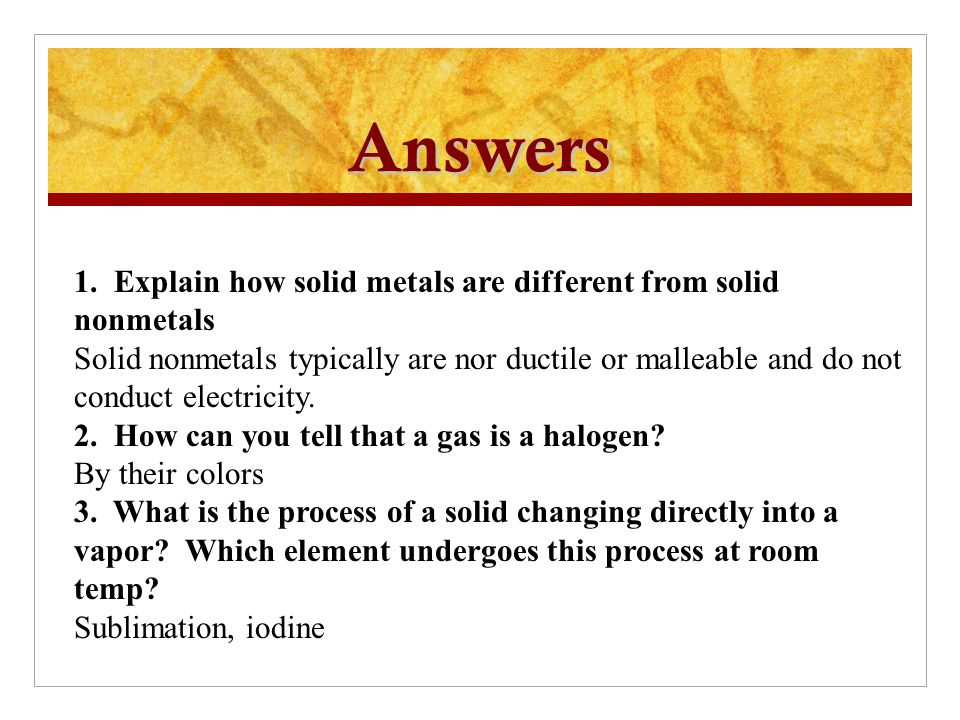
. Non-metals have lower melting point while metals have higher melting point. Most nonmetals have the ability to gain electrons easily. Metals are solid at room temperature highly conductive of heat and electricity and are malleable and ductile in nature.
Metals and non-metals have different properties. These are Present as liquid at room temperature. An element or substance that is not a metal they ade usually gases or solids at room temperature.
Non-metals are not strong or tough. Solid nonmetals are generally brittle with little or no metallic luster. Exceptional case for metal which is not solid at room temperature is gallium and mercury.
Metals conduct the heat and electricity to large extent while non-metals do not conduct the heat and electricity. Non-Metals have higher electronegativities. Other Apps - April 14 2022 Chemistry Metals And Non Metals 2 Chapter 4 Section 4 Are Poor Conductors Have Reactivity Solid Nonmetals Are Dull Brittle Non Malleable Non Ductile Ppt Download.
Non-metals can be solid liquid or gaseous at room temperature and are not conductive malleable or ductile. Metals are good conductors of electricity and heat. Solid nonmetals unlike solid metals are not malleable or ductile are brittle and powdery and are not good conductors of heat and electricity since the electrons in nonmetals are not free to move.
Metals usually come in solid forms while nonmetals can be solid liquid or gas. Explain How Solid Nonmetals Are Different From Solid Metals Get link. Non-metals can be solid liquid or gaseous at room temperature and are not conductive malleable or ductile.
Metals and non-metals have different properties. Metals generally form basic oxides while nonmetals are good oxidizing agents. A molecule that consists of two atoms of the same element.
Metals have a shiny appearance whereas non-metals are dull in appearance. The structure of a solid metal consists of closely packed. Non-Metals usually have 4-8 electrons in their outer shell.
Nonmetals have high ionization energies and electronegativities. Explain How Solid Nonmetals Are Different From Solid Metals Get link. Nonmetals however come in different colors.
Nonmetals are poor heat and electricity conductors Except mercury other metals are solid at room temperature. Metals usually exist in the crystalline structure. Properties of metals can be explained in terms of metallic structure and bonding.
They are generally poor conductors of heat and electricity. Nonmetal elements exist in all three states. Some non-metals are in solid form while some are gases at room temperature.
Metals have a certain luster or shine while non-metals are dull. How are solid nonmetals different from solid metals. There are various different elements present on Earth.
Exceptional case for Non- metals which is not solid or Gaseous at room temperature is Bromine. Nonmetals usually exist in an amorphous structure. Properties of Nonmetals.
Difference in Chemical Properties. The melting point of the. Chemical Properties of Non-Metals.
Nonmetals are electronegative in nature. Metals are usually hard and solid. There are various different elements present on Earth.
Generally Non-Metals have a transparent appearance like a thin sheet. Non- metals are mostly present As solid or gases. Non-metals are not sonorous in nature.
Metals are strong and tough. Nonmetals display a wide range of chemical properties and reactivities. Metals are solids at room temperatureExcept for mercury which is a liquid metal.
Metals are solid at room temperature highly conductive of heat and electricity and are malleable and ductile in nature. Non-Metals forms oxides which are acidic in nature. The solid nonmetals are usually soft.
Explain how solid nonmetals are different from solid metals. Metals have one to three electrons in their outer shell whereas non-metals have four to eight electrons. Non-metals are non-lustrous dull and cannot be polished.
Metals usually are good conductor of electricity and heat which can also be easily moulded. Therefore non-Metals readily gain or share valence electrons. The solid nonmetals are different from the solid metal.
Elements just to the left of. In contrast to metals solid nonmetals are dull. Furthermore noble gases and halogens elements are also referred to as non-metals.
Metals are electropositive in nature. The physical and chemical properties of metals and non-metals vary widely that is the properties of non-metals have less in common with each other than metals. Except for iodine.
This includes the alkali metals alkaline earth metals transition metals lanthanides and actinidesOn the periodic table metals are separated from nonmetals by a zig-zag line stepping through carbon phosphorus selenium iodine and radonThese elements and those to the right of them are nonmetals. Also metals tend to have a shiny surface. Metals have a high to moderate density whereas non-metals have low to moderate density.
Difference in Chemical Properties. Metals are mostly present as solid at room temperature. Most elements are metals.
The solid non-metals easily undergo sublimation and have low melting point. Metals are lustrous and can be polished. Nonmetals can range from solid liquid to gas.
They are dull and brittle.
2

Chapter 4 Section 4 Are Poor Conductors Have Reactivity Solid Nonmetals Are Dull Brittle Non Malleable Non Ductile Ppt Download
Elements And Their Properties Ppt Video Online Download

Nonmetals Chemistry For Non Majors



0 Comments